NeuGrasp: Generalizable Neural Surface Reconstruction with Background Priors for Material-Agnostic Object Grasp Detection
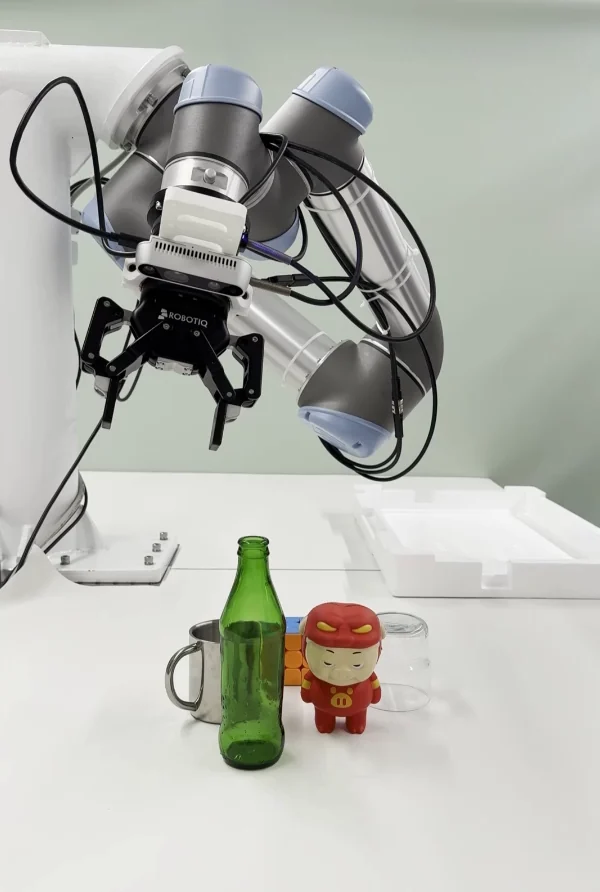 Approach
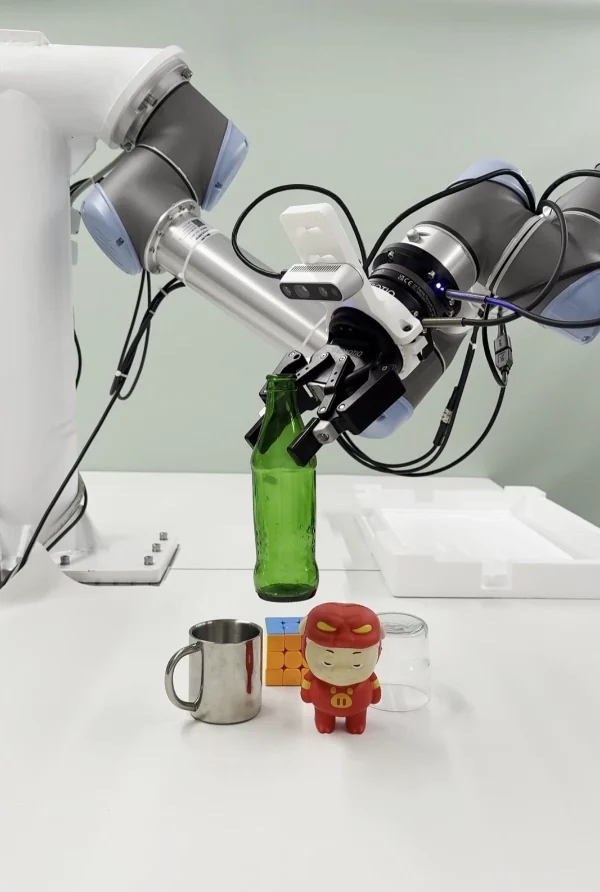 Lift
- 1 State Key Laboratory of Multimodal Artificial Intelligence Systems, Institute of Automation, Chinese Academy of Sciences
- 2 School of Artificial Intelligence, University of Chinese Academy of Sciences
- 3 Qiyuan Lab † Corresponding author
Overview
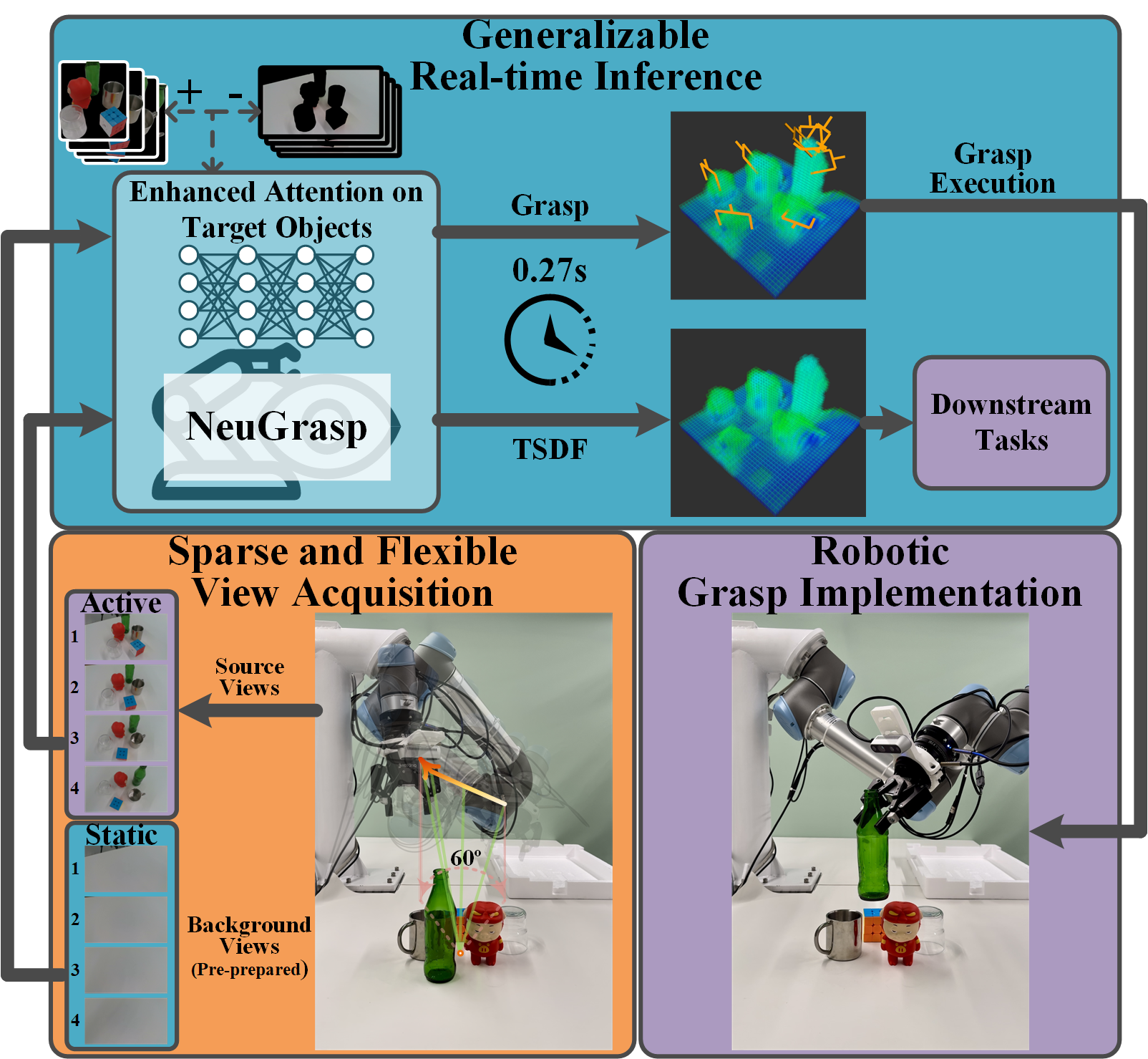
Glass and polished metal can leave holes in a depth map. We reconstruct these surfaces from four RGB views taken with a wrist-mounted camera.
We first photograph the empty workspace from the same viewpoints. NeuGrasp compares each scene with those reference images to identify foreground surfaces, then uses the reconstructed geometry to predict 6-DoF grasps. The same background images can be reused for subsequent scenes.
Real-robot experiments
We tested the simulation-trained model on a UR5 with a wrist-mounted camera and a two-finger gripper. For NeuGrasp-RA, we fine-tuned the same model on real images and grasp labels.
Grasping in clutter
Each run started with five household objects, either dropped into a pile or packed together upright. The objects used for testing were held out during real-world fine-tuning.
Original trial recordings| Model | Pile | Packed |
|---|---|---|
| NeuGrasp | 72 / 125 | 106 / 125 |
| NeuGrasp-RA | 120 / 125 | 121 / 125 |
Method
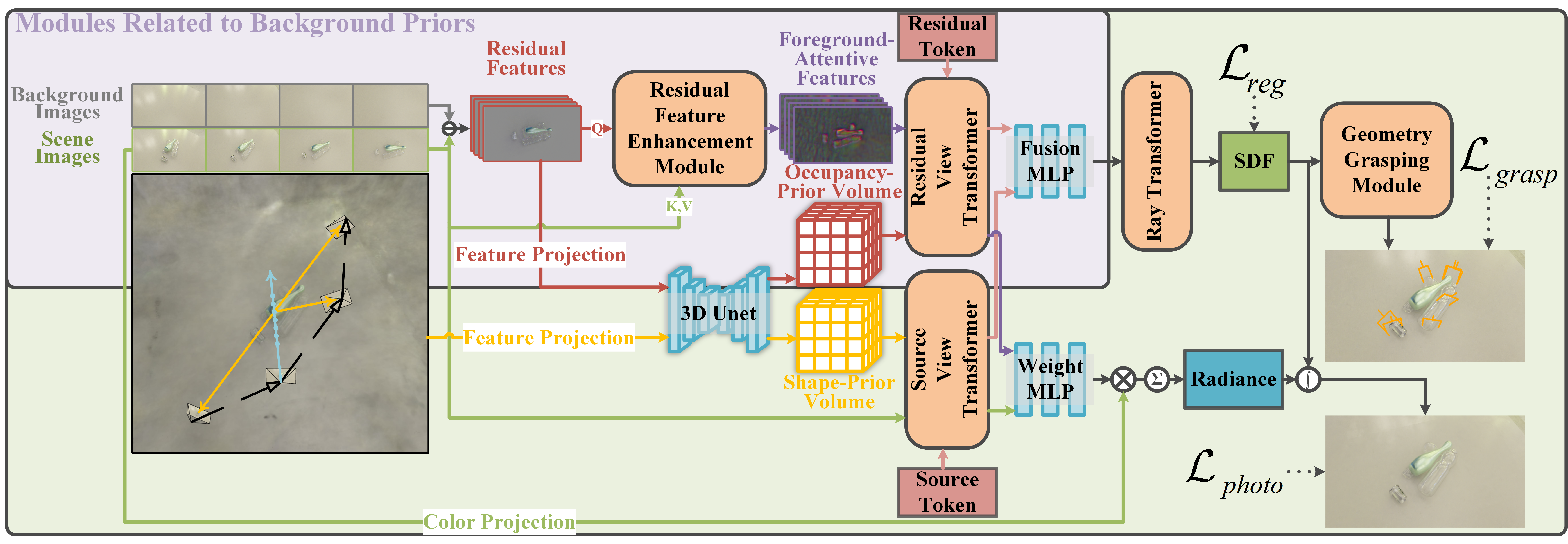
We train surface reconstruction and grasp detection jointly from multi-view RGB images and grasp labels, without depth supervision.
Foreground cues
Subtracting background features from scene features highlights objects that are difficult to distinguish in a single view. We project these residuals into 3D to estimate which regions of the workspace are occupied.
Surface reconstruction
View transformers fuse the image features with shape and occupancy priors. A ray transformer then aggregates features along each camera ray to estimate a signed distance field.
Grasp detection
For each candidate position, a 3D convolutional network reads the reconstructed geometry and predicts a grasp score, gripper orientation, and opening width.
Paper video
The presentation covers the camera trajectory, surface reconstruction, and grasping experiments.
Watch on YouTubeCitation
IEEE proceedings@inproceedings{fan2025neugrasp,
author = {Fan, Qingyu and Cai, Yinghao and Li, Chao and He, Wenzhe and
Zheng, Xudong and Lu, Tao and Liang, Bin and Wang, Shuo},
title = {{NeuGrasp}: Generalizable Neural Surface Reconstruction with
Background Priors for Material-Agnostic Object Grasp Detection},
booktitle = {2025 IEEE International Conference on Robotics and Automation (ICRA)},
pages = {3197--3203},
year = {2025},
doi = {10.1109/ICRA55743.2025.11127348}
}Contact
Qingyu Fan · qingyu.fan.ai@outlook.com
Yinghao Cai · yinghao.cai@ia.ac.cn